







design insights


Learn how reversed text can add intrigue, emphasize key elements, and boost engagement in your creative designs.
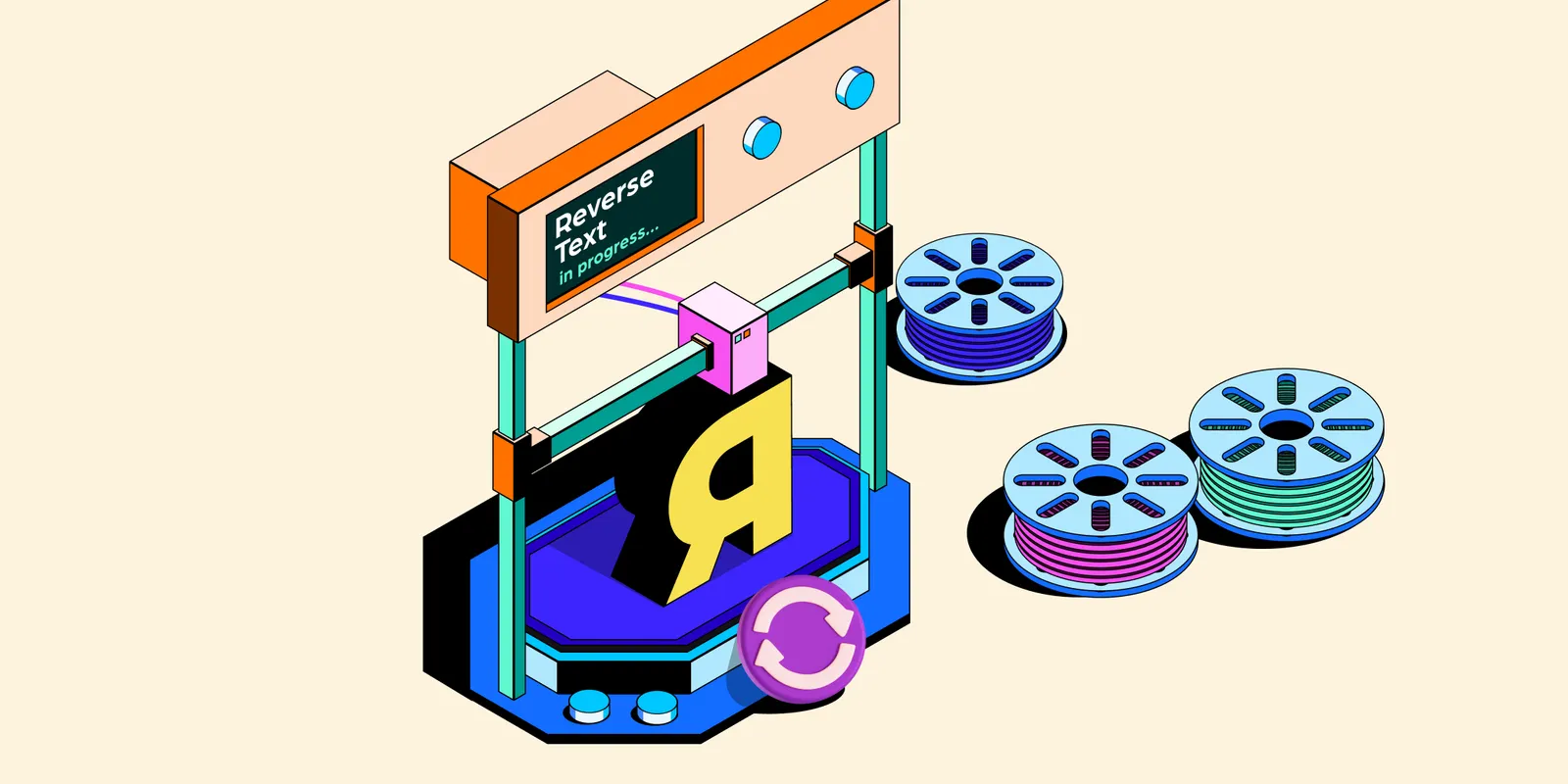
A creative design is a thoughtful collection of catchy text and appealing visual elements. You can’t think of overlooking a few and paying attention to others if you want your design to stand out from the crowd and grab the target audience's attention. A great way to surprise your audience with creativity is to bring something out of the blue and use it tactically to add value to your design.
Adding reverse text, or flip type, could work well if you use it strategically. However, it is observed that many designers consider it useless, which is nothing but a false assumption. As a designer, you must develop ideas to make backward text valuable to your project. This article will help you understand the ins and outs of the tactical use of reverse text in creative designs.
Read on to learn more.
Reverse text refers to any text featuring words or letters written backward. Making text reverse is simple. Various Methods are available to help you do it quickly.
The easiest method to reverse text is using an online tool. The online reverse text generator can easily make text reverse through it by flipping it horizontally, making the text written backward, and reversing the order of words or letters in a sentence, phrase, or passage. Making text reverse online is pretty straightforward. The text reverser doesn’t require installation or cost users a single dime to help them generate backward text. You also don’t need a particular device, browser, or operating system.
You can also use graphic design software to reverse text. Various renowned design tools enable you to flip text. You can quickly draw a structure and add text to it. After adding text, simply highlight it and look for the option to flip it. A pro of using graphic design software to reverse text is its ability to give you the flexibility to reverse text horizontally or vertically.
Some people think of reversing letters or words on their own. However, this method may fail to work well because it will take significant time and effort. Chances of wrong order of words and letters also exist. You may also need to correct mistakes while tarnishing your creative design's look and creating a bad impression. Hence, consider using methods or techniques that help you avoid mistakes and make the process easier.
There are multiple reasons why using reverse text in creative design could be a strategy. However, many people disregard using flipped text in their innovative design because they don’t know how it can add value to their project. Here are some reasons that will help you understand how it can be a good idea that will lead to fruitful results.
Now that you have understood the method of making text reverses and its importance in creative design projects, it is time to learn how to make the most of it.

Any logo with something unique to offer will surely grab the audience's attention. Many designers try to create something out of the box to impress viewers and intrigue them to pay attention to a brand’s visual signature. Believe it or not, a reversed or flipped letter or word placed tactically in a logo can make it unique and make people curious to learn more about it.
So, when you think of creating a logo for a brand that works in the fashion, apparel, footwear, or fast food industry, a logo featuring reversed text elements could be a perfect shot. It will make the logo appealing and help the brand stand out because of a unique visual representation with a genius story.
A prominent real-life example of using reverse text to make a brand’s logo design appealing is available in the form of Nexen. If you closely monitor its logo, which features the letter ‘E’ two times. The designer who created that logo has shaped one ‘E’ backward to make the content appealing. This slight modification in the logo using the reverse text certainly appeals to the targeted audience.

Whether crafted for the web or promotion, a creative design engages the targeted audience and communicates a particular message. However, it only succeeds when it draws viewers' attention to a specific part of the content that features that message. Viewers will likely overlook such a section if the design appears monotonous.
The best way to guide the targeted audience's focus to that specific section is to use a creative idea that can easily direct their attention toward the information that is valuable to them. Tactical use of a flipped keyword or phrase in that section can do the trick and make people curious about the info featured by that particular text block. Hence, flipped text can be used for emphasis.
As discussed earlier, creative designs are meant to engage the targeted audience, grab their attention, and convey a particular message or share valuable information. However, viewers don’t pay much attention to any visual or graphic they see online or offline, such as a brochure or flyer. They only do it when they find something unique or an element requiring additional effort.
Making text reverse and adding it to a creative design enables you to create visual illusions in your content. These visual illusions evoke curiosity and demand viewers to read the content attentively. Viewers also engage with the design mentally to correct the text appearing with reversed words or letters so they can read it. This phenomenon leads to an additional layer of engagement.
Creative design is not always about promoting a product or conveying a message. Sometimes, it is meant to engage art enthusiasts and build an emotional connection. Such a project requires designers to go beyond basics and try something odd or irrelevant. Reversed or flipped text can easily earn its spot in abstract designs.
This possibility is to promote artistic vibes through the design project. Abstract art could convey a hidden yet meaningful message that is not visible to many. Reversed text can be added to an abstract design to make it complex and intriguing, giving the overall project an artistic vibe.
You can view the use of mirrored text in abstract design projects to ensure an artistic feel by observing Stefan Sagmeister’s “Things I Have Learned in My Life So Far.”
Sometimes, the main objective of a designer is to ensure a creative design that reflects minimalism. It is only possible when the entire project revolves around a minimalist layout. However, providing a minimalist design can be overwhelming. The process becomes more complicated when you can’t think of any strategy to work your way.
Consider using backward text in your creative design if you ever encounter such a situation. It can be a powerful design tool. You only need to use it strategically while keeping the content readable and aligned with other design elements. So, use it to reflect a clean and modern aesthetic that will grab the targeted audience’s attention.
Working on a creative design doesn’t mean you always have to keep everything in balance, especially when the design context gives you flexibility. You can add modern vibes to the overall project using reversed text like a logo design. It will help you make the design look modern and playful. Such a tactic would work perfectly if your brand targets Gen-Z.
Flipping text in an otherwise severe and monotonous design can add a touch of fun to your project. You can also use it to communicate hidden messages or a relevant joke. This would be an excellent surprise for viewers who will attentively go through your entire design. If you are working on a web design project, you can use reverse text to highlight the interactive section and make the user tap it to reveal the actual message.
You can get a real-life example of playful design using the reverse text by viewing the logo of ‘Toys R Us.’ The R in its logo is reversed to add playfulness to the design. Since the targeted customer base of this brand is Gen-Z and beyond, this design serves its role perfectly well. It efficiently grabs the attention of children who feel intrigued to buy the toys it offers.

Considering reversed or flipped text as a useless design element could be the biggest mistake, especially if you are working on a creative design project targeting younger audiences. Additionally, it can be a perfect way to highlight a section or add a visual hierarchy to your design.
We have discussed a few ways to make text reverse, its importance, and its applications. Hopefully, you will have plenty of takeaways on the significance of flipped text so that you can tactically use it in your design projects. We wish you luck with your upcoming design tasks!


 Save 33%

